


Combiner Box
Our goal is to become your true partner in the field of combiner box China. Changsong Cowns modern R&D center for developing electric products with full-line of high-tech moulding, manufacturing equipment and great strength of technical support, besides advanced design forces powered by first class engineering teams with super industrial computer systems. In order to keep the leadship in electrical industry, Changsong continuous increase and update manufacturing facilities, keep improving techniques and adopting the most advanced inspect instrument.
Why choose us
Product Application
Our products include circuit breakers, switchboards, AC contactors, meters, relays, fuses, control units, etc. These products are widely used in various important places where power outages are not allowed, such as high-rise buildings, residential areas, hospitals, airports, docks, fire protection, metallurgy, chemical industry, textiles, etc.
Product Market
Changsong has obtained ISO9001 quality system certification, ISO14001, OHSAS18001, CB certification; SEMKO and CE certification, etc.
Fast Delivery
We ensure complete packaging, ensure product quality, and transport the products to the destination at the first time.
Our Service
During the order production process, customers can communicate with us at any time to understand the production progress. At the same time, we provide high-quality after-sales service to meet the different needs of customers.


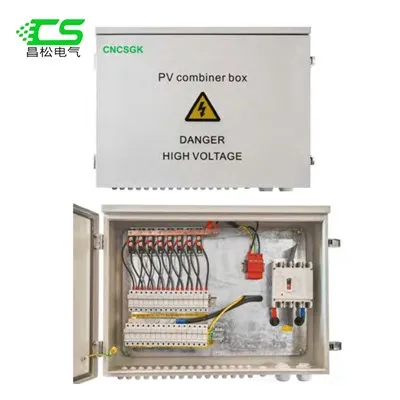


Advantages of Combiner Box
Elevated Power Distribution
One of the significant advantages of combiner boxes lies in their adeptness at amalgamating the incoming power from multiple strings into a solitary primary conduit. This streamlines the dispersion of power to the solar inverter, curbing both labor and material expenses by minimizing wire usage.
Seamless Setup and Upkeep
In residential environments, compact combiner boxes are deployed to consolidate a limited number of string connections to a central hub, streamlining the processes of installation, disconnection, and maintenance.
Optimized Power Loss Prevention
Optimal placement of the combiner box within the solar array is paramount in mitigating power loss. By strategically positioning the combiner box, both voltage and power losses can be kept to a minimum, resulting in an overall enhancement of system efficiency.
Third-Party Certification
Opting for third-party certification is paramount when it comes to selecting a combiner box. This component serves as the initial connection point to the solar modules’ output. A malfunctioning combiner box can lead to hazardous situations, including fires and damage to equipment.
Incorporating Whips
A cutting-edge development in combiner box design involves integrating whips—pre-fitted wire lengths with solar connectors. This innovation eradicates the necessity for on-site drilling and intricate installations, streamlining the connection process to a level akin to plugging in a toaster.
Applications of Combiner Box
Combiner boxes are imperative in any renewable energy project, which includes:
Solar Photovoltaic (PV) Systems
Combine power coming out of multiple strings of solar panels to feed the inverter.
Wind Energy Systems
Integrate electricity generated by multiple turbines.
Hybrid Systems
Efficiently manage energy from diverse sources like solar panels and wind turbines.
Type of Combiner Box
Standard combiner box
This is the most basic type, used to combine the output current of solar panels into one output and directly deliver it to the inverter. Usually includes fuses or circuit breakers configured for each input, and current over-line.


Photovoltaic combiner box
It is mainly used to combine the output current of multiple solar panels and then unify the pipeline to the photovoltaic device.
Series combiner box
To organize the design of solar panels in strings, this combiner box handles the output of multiple strings and combines them. It often contains a monitoring system for checking the performance of each string.


DC combiner box
This type of combiner box is used in systems with direct current (DC) output, capable of combining multiple DC sources, and has protection and switching functions.
AC combiner box
In a solar panel integrated PV system, each panel has an alternating current (AC) output. The AC combiner box combines these outputs before sending power to the grid or central PV.


Smart combiner box
Equipped with advanced monitoring and communication capabilities, smart combiner boxes can track performance data for each connected string or panel, detect faults, and often provide remote diagnostic capabilities.
Precautions for Installing a Combiner Box
Choosing the Right Installation Location
The installation location of the combiner box directly impacts its ability to resist water, dust, and corrosion. To ensure the combiner box functions well in outdoor environments, careful consideration must be given to its placement. First, avoid installing it in low-lying areas that may collect water, which could lead to water intrusion. It is generally recommended that the combiner box be installed at least 0.5 meters above ground level to minimize the risk of water damage, especially in areas prone to heavy rainfall or flooding.
Using a Combiner Box with a High Protection Rating
The protection rating of a combiner box is a key indicator of its waterproof and dustproof capabilities. For outdoor installations, the combiner box should have a protection rating of at least IP65 or higher. This rating ensures that the combiner box is fully protected against dust ingress and is resistant to water from any direction. During installation, it is essential to verify that the enclosure is intact, and all seals and gaskets are in good condition.
Choosing Appropriate Materials for Corrosion Resistance
When installing a combiner box, it is crucial to account for corrosive environmental factors, especially in coastal or industrial areas where the air may contain high levels of salt or corrosive gases.The enclosure of the combiner box should be made of stainless steel, aluminum alloy, or other corrosion-resistant materials, as these materials can withstand exposure to salt, acidic gases, and other corrosive elements in the air.
Maintance of Combiner Box
Periodically remove dust and other debris from the surface of the combiner box to prevent accumulation that could affect performance. Ensure the ventilation ports of the combiner box are unobstructed to maintain effective heat dissipation.
Regularly check the output voltage and current of the combiner box to ensure consistency with design parameters. Utilize smart monitoring systems to regularly review operational logs and promptly identify potential issues.
If signs of terminal erosion or poor contact are found, replace damaged parts promptly. If there is instability or a significant drop in current output, check if the solar panels are functioning properly and whether there are damages to the connecting cables.
Ensure that the power is disconnected before any maintenance or troubleshooting to guarantee safety. Employ professional electrical testing and repair tools, avoiding the use of non-standard equipment.