


Dc MCB
Why Choose Us
Our Products
Our products include circuit breakers, panel boards, AC contactors, meters, relays, fuses, control units, and many other electrical accessories such as LED lighting.
Our Certificates
Changsong has obtained ISO9001 quality system certification, ISO14001, OHSAS18001, CB certification, SEMKO, and CE certification. Our products are warmly welcomed not only in the domestic market but also in overseas markets year after year.
Our Company
Chang Song Electric Co., Ltd. was founded in 1995. With more than 35,000㎡ of manufacturing space and 260 employees, it has become one of the leading manufacturers of industrial electric products in China. It is also one of the earliest factories in the industry, with nearly 20 years of experience in producing and developing electric equipment.
Our Advantages
Changsong owns a modern R&D center for developing electric products, with a full line of high-tech molding and manufacturing equipment and strong technical support. Additionally, advanced design capabilities are powered by first-class engineering teams with superior industrial computer systems.
What is Dc MCB?
A miniature circuit breaker is a device that closes a circuit when its rated current exceeds its limit. It can also be replaced by a fuse or isolator with a fuse. MCBs can be manually or automatically operated.


DC MCB of type B:
The design of the MCB allows it to trip at a current of 3 to 5 times the rated current. Typically, you can utilize these MCBs for inductive or resistive loads with low switching surges. As a result, they are appropriate for household and light business use.
DC MCB of type C:
The design of the MCB allows it to trip at a current of 5 to 10 times the rated current. Typically, you can utilize these MCBs in fluorescent lights and small motors with high inductive loads and high switching surges. As a result, they’re appropriate for industrial and commercial applications that require much induction.
DC MCB of type D:
The design of the MCB allows tripping at a current of 10 to 20 times the rated current. Professionals typically employed it for highly high inductive loads with high surge currents. As a result, X-ray machines, UPS systems, huge winding motors, and industrial welding equipment can all benefit from them.
Voltage Rating: Determine the voltage rating of your DC system. DC MCBs are available in different voltage ratings, such as 250V, 500V, 1000V, etc. Choose a DC MCB with a voltage rating that matches your system voltage.
Current Rating: Calculate the maximum current that will flow through the circuit where the DC MCB will be installed. This will help you determine the appropriate current rating for the MCB. Ensure that the selected MCB's current rating is higher than the maximum current expected in the circuit.
Breaking Capacity: Consider the breaking capacity or interrupting rating of the DC MCB. It indicates the maximum fault current that the MCB can safely interrupt without getting damaged. Ensure that the MCB's breaking capacity is sufficient to handle the fault current in your system.
Trip Characteristics: Evaluate the trip characteristics of the DC MCB. Different MCBs have different trip curves, which describe how quickly they respond to overcurrent conditions. Choose a trip curve that suits the specific requirements of your system.
Environmental Conditions
Take into account the environmental conditions in which the DC MCB will be installed. Factors such as temperature, humidity, and vibration can affect the performance and durability of the MCB. Ensure that the selected MCB is suitable for the intended environment.
Compliance with Standards
Verify that the DC MCB complies with relevant industry standards and regulations. Look for certifications such as UL, CE, or IEC to ensure the MCB meets the required safety and quality standards.
Brand and Reputation
Consider the reputation and reliability of the manufacturer or brand. Opt for a reputable brand known for producing high-quality electrical components.
Advantages Of Dc MCB


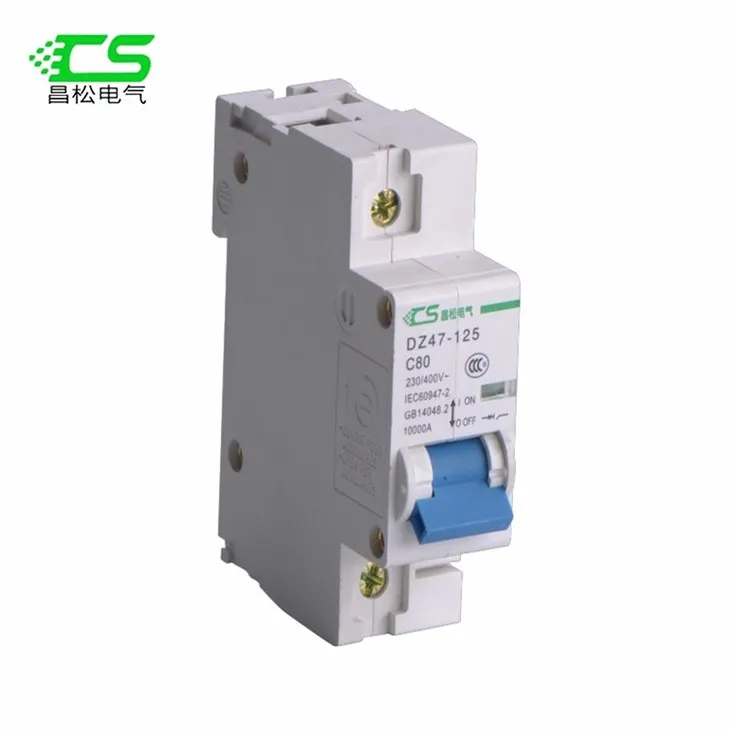

Simple and Easy to Use: Miniature circuit breaker is more sophisticated than a fuse, which must be replaced whenever it trips or overheats. It works on a new, more efficient mechanism that eliminates the need for fuses. The thermal tripping effect, which works with a bimetallic strip, causes the trip lever to be displaced, causing the trip coil to strike the trip lever. This action opens the contacts in the MCB.
Reliable and Convenient: The MCB is designed to operate at a rated frequency. Its rated current and ultimate breaking capacity are defined by trip curves. The rated and tripped currents of an MCB are controlled by ambient temperature, which affects the time it takes for the device to trip. These are two of the main benefits of an MCB. Because of their ability to work in harsh environments, MCBs are a safe, reliable, and convenient alternative to fuses.
Improved Safety: The MCB has improved operational safety. It can handle voltage fluctuations and can be remotely switched on and off. It is also compatible with large inductive loads, such as motors and electric dryers. The MCB is a great choice for homes and businesses with high electrical usage. The MCB is more sensitive than a fuse, making it a better choice in certain applications. An MCB is a safer alternative to a fuse.
Less Replacement Cost: When compared to a fuse, MCBs can also be cheaper. In some cases, the MCB can cost less than a conventional circuit breaker. The MCB will cost more, but it is well worth the investment as you can reuse it without changing the device.
Can Be Used Anywhere: Another advantage is that it can be used anywhere, including on the floor. These breakers are more resistant to temperature changes than their counterparts and will prevent a fire from breaking out.
Sensitive to Current: The MCB has several advantages over a fuse. It is more sensitive to current than a fuse and breaks the circuit when it detects an abnormality. It is also a good choice for homes and businesses that are concerned with electrical safety. These benefits make it the safer option for many people. If you’re looking for a replacement for a blown a fuse, it may be a good idea to use an MCB instead.
Overload protection: Using an MCB has many advantages over a fuse. An MCB is designed to protect electrical equipment, human life and property from a fire. It breaks the circuit when an overload occurs, while a fuse will break the circuit when a short has occurred. A fuse is reusable, but it will need to be replaced after the first failure. It is a safety device.
Connecting a Miniature Circuit Breaker for DC Applications
Switch Off The Power Supply: Before working with any electrical components, always ensure that the power supply is disconnected to prevent shocks and accidents.
Select The Appropriate MCB: Choose an MCB with the correct voltage and current ratings for your specific DC application. Consult the manufacturer's guidelines or consult a professional if you are unsure.
Identify The Terminals: Examine the MCB and locate the input (line) and output (load) terminals. In most cases, the input is marked as "L" and the output as "T".
Connect The Input Wire: Strip the insulation from the end of the input wire and insert it into the input terminal of the MCB. Secure the connection by tightening the terminal screw.
Connect The Output Wire: Similarly, strip the insulation from the end of the output wire and insert it into the output terminal of the MCB. Tighten the terminal screw to secure the connection.
Mount the MCB: Attach the MCB to a DIN rail or an appropriate mounting base according to the manufacturer's instructions.
Test the MCB: Once the MCB is connected and mounted, turn the power supply back on and test the MCB by pressing the test button. The MCB should trip, indicating that it is functioning correctly. Reset the MCB by flipping the switch back to the "on" position.
The Importance of DC MCBs in Solar PV Systems
The importance of DC MCBs in solar PV systems cannot be overstated. Without a DC MCB, the system is at risk of damage from overcurrent and short-circuit faults. These faults can be caused by a variety of factors, including wiring problems, component failure, or lightning strikes.
Current Rating
The current rating of the DC MCB determines the maximum current that it can handle without tripping. It is important to choose a DC MCB with a
current rating that is appropriate for your system. If the current rating is too low, the DC MCB will trip frequently, disrupting the system. If the current rating is too high, the DC MCB may not trip when it needs to, putting the system at risk of damage.
Breaking Capacity
The breaking capacity of the DC MCB determines the amount of current that it can safely interrupt in the event of a fault. It is important to choose a DC MCB with a breaking capacity that is appropriate for your system. If the breaking capacity is too low, the DC MCB may not be able to interrupt the fault, putting the system at risk of damage. If the breaking capacity is too high, the DC MCB may not be able to trip when it needs to, putting the system at risk of damage.
Voltage Rating
The voltage rating of the DC MCB determines the maximum voltage that it can safely interrupt. It is important to choose a DC MCB with a voltage rating that is appropriate for your system. If the voltage rating is too low, the DC MCB may not be able to interrupt the fault, putting the system at risk of damage. If the voltage rating is too high, the DC MCB may not be able to trip when it needs to, putting the system at risk of damage.
Type of Protection
There are two types of protection provided by DC MCBs: Type B and Type C. Type B protection is suitable for loads with a high inrush current, such as motors or transformers. Type C protection is suitable for loads with a low inrush current, such as lighting or electronics. It is important to choose a DC MCB with the appropriate type of protection for your system.
Selecting the Right MCB for Your DC Application
Voltage
Ensure the MCB's voltage rating matches your system's voltage requirements.
Current
Choose an MCB with a current rating that corresponds to your system's maximum current demand. Avoid selecting an MCB with a lower current rating, as it may trip prematurely.
Breaking Capacity
Select an MCB with a breaking capacity that can handle the maximum short-circuit current in your system.
Trip Curve
MCBs have different trip curves (B, C, D) that determine their response to overloads and short-circuits. Choose a trip curve that suits your application's requirements.
Internal Structure Of Dc Mcb
Operating Mechanism: Mainly to ensure that the product can be reliably closed and opened normally. Enable the product to trip smoothly in the event of a malfunction, without causing product failure due to jamming, failure to reset, or other reasons.
Thermal Trip Unit (bimetallic Strip) : It is mainly to ensure that when the line is overloaded, it can be reliably released within a predetermined time to prevent line burning and equipment damage. Under overload, the bimetallic strip will bend towards the low expansion layer according to the current.
Electromagnetic Trip System: It primarily ensures reliable tripping within a predetermined time when a short circuit occurs in the circuit, in order to prevent damage to the circuit and equipment.
Contact System: It primarily makes and breaks the circuit, supplies or cuts off the load current.
Arc Extinguishing System: Its main function is to guide the intense electric arc generated between the moving and static contacts in case of a fault towards the arc extinguishing chamber, where the arc is divided into short arcs using magnetic grids with attractive force, cool down the arc, and eventually extinguish it.
Enclosure: Mainly used for fixing various components and providing insulation protection.
Terminal Block: Used for users to connect input and output wires.
Certifications

Our Factory
Changsong Cowns modern R&D center for developing electric products with full-line of high-tech moulding, manufacturing equipment and great strength of technical support, besides advanced design forces powered by first class engineering teams with super industrial computer systems. Thus, each piece of the product is fully assured with top-reliable quality, scientific and novel design as well as excellent workmanship.
