


Dc MCCB
Why Choose Us
Our Products
Our products include circuit breakers, panel boards, AC contactors, meters, relays, fuses, control units, and many other electrical accessories such as LED lighting.
Our Certificates
Changsong has obtained ISO9001 quality system certification, ISO14001, OHSAS18001, CB certification, SEMKO, and CE certification. Our products are warmly welcomed not only in the domestic market but also in overseas markets year after year.
Our Company
Chang Song Electric Co., Ltd. was founded in 1995. With more than 35,000㎡ of manufacturing space and 260 employees, it has become one of the leading manufacturers of industrial electric products in China. It is also one of the earliest factories in the industry, with nearly 20 years of experience in producing and developing electric equipment.
Our Advantages
Changsong owns a modern R&D center for developing electric products, with a full line of high-tech molding and manufacturing equipment and strong technical support. Additionally, advanced design capabilities are powered by first-class engineering teams with superior industrial computer systems.
What is Dc MCCB?
A DC MCCB, or Direct Current Miniature Circuit Breaker, is a protective device designed specifically for use in direct current (DC) electrical systems. Unlike its alternating current (AC) counterpart, an MCCB, a DC MCCB is engineered to cope with the unique characteristics of DC circuits, which include unidirectional flow of current and the absence of zero crossings.


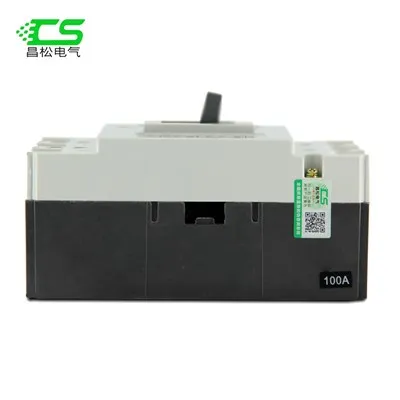
Molding Case
The molded case or frame is the cushion that keeps all parts of the circuit breaker in place. It is solidly built from ‘glass polyester’ or ‘thermoset composite resin that gives a great nonconducting strength despite its compressed size.
Terminals
The terminals serve as connectors between external conductors and molded cases. They should be connected properly to prevent unusual heat production.
Operating Apparatus
This is the switch that opens and closes the molded case. Its handle connects the pull of the device and manual push.
Trip 'Unit
The Trip System is composed of temperature and current-reactive electromagnetic sensors that trigger the Operating Apparatus in case of short-circuit or current overloads. Its button can be pressed to reset the circuit breaker.
Arc Chamber
The Arc Extinguisher’s primary role is to curb and split the arc that can damage your circuit breaker. The action results in exterminating the current flow in the circuit breaker. Inside the arc chamber are contacts. Their role is to conduct and disrupt functions. Arc ‘Runners, on the other hand, function as new electrodes for the arc. Arc chutes, on the other hand, compress the arc in the middle of sidewall insulators.
Understanding Dc MCCB features and ratings
Rated Current (In): The tripping point of the MCCB during overload protection.
Rated Frame Current (Inm): The maximum current that the device can handle. It determines both the frame size of the breaker and the upper limit of the rated current.
Rated Working Voltage (Ue): The rated voltage for the constant use of the MCCB.
Rated Insulation Voltage (Ui): The highest voltage that the MCCB can protect against in laboratory conditions.
Rated Impulse Withstand Voltage (Uimp): This value represents the circuit breaker's ability to endure transient peak voltages resulting from switching surges or lightning strikes, thus determining its resilience against transient over-voltages.
Ultimate Short Circuit Breaking Capacity (Icu): The maximum fault current value that the MCCB can withstand.
Operating Short Circuit Breaking Capacity (Ics): The maximum fault current that the MCCB can withstand before being permanently damaged. The higher this value, the more robust the MCCB.
Electrical Life: The maximum number of trips the MCCB can withstand before becoming non-operational.
Mechanical Life: The maximum manual operations allowed before the MCCB fails.
Types of Dc MCCB


Type B: This type of molded case circuit breaker trips between 3-5 times the rated current. Tripping time is 0.04-13 seconds. These mostly have resistive, domestic applications and can handle low surge currents.
Type C: These trip between 5-10 times their rated current. Tripping times fall within the range of 0.04-5 seconds. Applications involve relatively modest inductive loads, such as small motors, transformers, and electromagnets typically used in industrial settings. Suitable for higher surges.
Type D: Type D MCCBs are known to trip between 10-20 times their rated current, and their tripping time ranges from 0.04 to 3 seconds. These MCCBs exhibit the highest surge tolerance and are thus selected for applications with extremely inductive loads like large electrical motors commonly found in industrial environments.
Type K: These trip when the current reaches 10-12 times their rated current. Tripping time falls between 0.04 to 5 seconds. Applications involve inductive loads like motors.
Type Z: Type Z MCCBs are the most sensitive among MCCBs, tripping when the current reaches only 2-3 times their rated current. They have the shortest tripping time and are employed for applications where extreme sensitivity is essential. This includes protecting semiconductor-based medical equipment and other costly devices that are susceptible to low current surges.
Characteristics Of Dc Mccb
Rated Limit Short Circuit Breaking Capacity ICU
There are two kinds of breaking capacity indexes of circuit breaker: rated limit short-circuit breaking capacity ICU and rated operating short-circuit breaking capacity ICs. ICs, as a characteristic parameter, not only considers the breaking capacity of the circuit breaker, but also serves as a breaking index, within the specified number of breaking short circuit faults, the normal operation of the circuit breaker can be ensured.
Current Limiting And Breaking Capacity
When the circuit breaker is short circuited and the contact is opened rapidly, an arc is generated, which is equivalent to a rapidly increasing arc resistance in series in the line, thus limiting the increase of fault current. The less the breaking time of circuit breaker is, the closer ICs will be to ICU, and the better current limiting effect will be. The adverse effects of electromagnetic effect, electric effect and thermal effect caused by short circuit current on circuit breaker and electrical equipment can be greatly reduced, and the service life of circuit breaker can be prolonged.
Short Circuit Protection
Short circuit protection is short circuit instantaneous trip. Attention should be paid to timely adjust the setting value of the protection after the load changes, so as to prevent the power supply quality from being affected by frequent tripping when the setting value is too small. Or the line and equipment cannot be effectively protected if the setting value is too high.
Overload Delay Protection
Overload delay protection means that the load current exceeds the limited range of the equipment, and there is a risk of burning the equipment. The protection device can cut off the power supply within a certain period of time. Overload has a process of heat accumulation, and the protection action does not need to be too fast. For short-time over-current, the protection should not act.
Isolation Function
The isolation function is to require that the leakage current after the circuit breaker is disconnected will not cause harm to people and equipment. After several short circuit trips, the switch performance decreases and the leakage current increases. For human body, the leakage current below 30mA is the safe leakage current, while in the harsh environment, the leakage current over 300mA lasts for more than 2 hours, which may cause insulation damage and lead to phase to ground short circuit and fire.
Application of Dc MCCB
Motors
MCCBs protect motors by having their settings modify the inrush current and give the delay it may need. When done correctly, the motors are protected from overloads without triggering the tripping mechanism.
Welding Machinery
Welding machines utilize high currents, which normal circuit breakers cannot handle. An MCCB can be used to protect welding machines by connecting the machine to its own circuit breaker.
Generators
It is widely known that generators produce high levels of amps and need costly gen-sets. To shield the linked circuits and generator from faults that may happen in the system, having an MCCB is essential as it can handle its high current ratings and protects your generators as needed.
Capacitor Banks
MCCB lessens the currents, which in turn, corrects the ‘power factor’ in commercial and industrial-level systems.
Modifiable Trip Modes
These settings allow MCCBs to be utilized in low-current appliances in the household. This makes it an all-rounder use as it can be adjusted between low and high-current settings.
Electric Feeders
MCCB has adjustable settings that can be adjusted and allows it to handle high currents. If applied to electric feeders that produce hundreds of amps, MCCB can dissipate these energies easily. It also acts as its primary ‘incoming breaker.
Main parameters of Dc MCCB
Breaker shell frame grade
The rated current of circuit breaker shell level refers to the rated current of the maximum release that can be installed in the frame and plastic shell with the same basic size. The rated current of the circuit breaker refers to the current that the release in the circuit breaker can pass for a long time, also known as the rated current of the circuit breaker release. In the same series, there are multiple rated currents in the same shell rating, and there are multiple rated currents in the same shell rating current.
Rated insulation voltage
The rated insulation voltage is the voltage value of the designed circuit breaker, and the electrical clearance and creepage distance shall be determined according to this value. Some circuit breakers do not specify the rated insulation voltage, the maximum value of the rated working voltage should be regarded as the rated insulation voltage. In any case, the maximum rated working voltage should not exceed the rated insulation voltage.
Rated limit short circuit breaking capacity
The rated limit short circuit breaking capacity is breaking capacity under specified conditions. After acting according to the specified test procedure, it is not considered that the circuit breaker continues to carry its rated current.
Accessory function
As the derivation and supplement of circuit breaker functions, accessories add control means and expand protection functions for circuit breakers. They are an integral part of circuit breakers, mainly including auxiliary contacts, alarm contacts, shunt release, under voltage release, electric operating mechanism, external rotary operating handle and other accessories.
(1) The auxiliary contact is mainly used to display the opening and closing status of the circuit breaker, but it can not show whether it is fault tripping. It is connected in the control circuit of the circuit breaker. The rated current of the molded case circuit breaker shell frame grade is 100 as the single break point transfer contact, and the bridge type contact structure is 225 and above, with the agreed heating current of 3A; Two normally open and two normally closed can be installed for shell frame with rated current of 400 and above, and the agreed heating current is 6A.
(2) Alarm contact is mainly used for the free tripping of the circuit breaker when the load is overloaded, short circuit or under voltage. The working current of alarm contact is AC380V, 0.3A, dc220v, 0.15A, which will not exceed 1A generally, and the heating current can be 1-2.5a.
(3) Shunt release is a kind of remote control opening accessories, its voltage can be independent of the main circuit voltage, shunt release is short-term working system, the coil power on time generally can not exceed 1s, otherwise the coil will be burned. In order to prevent the coil from burning out, a microswitch is connected in series in the shunt release coil of the moulded case circuit breaker. When the shunt release is powered on and the armature is closed, the microswitch changes from the normally closed state to the normally open state. Because the control circuit of the power supply of the shunt release is cut off, even if the button is pressed artificially, the shunt coil will not be powered on. When the circuit breaker is closed again, the microswitch will be in the normally closed position again. The shunt release has a variety of control voltage and different power frequency, which can be used in different occasions and different power sources.
(4) Under voltage release is used as long-term voltage protection of lines and power equipment. When in use, the coil of under voltage release is connected to the power supply side of the circuit breaker. The circuit breaker can only be closed after the undervoltage release is powered on, otherwise the circuit breaker cannot be closed. The user should confirm whether the working voltage of the circuit is consistent with that of the under voltage release. The operating range of under voltage is 70% ~ 35% UN. Under voltage release also has a variety of rated operating voltage and different power frequency, which can be used in different occasions and different power supply.
(5) The electric operating mechanism is used for automatic control of circuit breaker and remote closing and opening. There are two kinds of electric operating mechanism and electromagnetic operating mechanism: the electric operating mechanism is driven by motor, which is generally applicable to the circuit breaker with shell rating of 400A and above; the electromagnet operating mechanism is applicable to the circuit breaker with shell rating of 225A and below.
Arcing distance
When a circuit breaker breaks a large short-circuit current, its moving and static contacts are separated to produce an arc. A part of the arc or ionized gas is ejected from the arc nozzle at the power supply end of the circuit breaker. The arc itself is a huge current, which is easy to cause phase to phase short-circuit and ground short-circuit accidents between bare conductors, between bare charged bodies and "ground"(the metal shell of the complete equipment is grounded). To ensure safety, users should keep a certain distance according to the data provided by the manufacturer's product samples or operation instructions. If the height distance of distribution box and cabinet is not enough, products with small arc distance or zero arc can be selected to ensure the safety of power consumption.
Certifications

Our Factory
Changsong Cowns modern R&D center for developing electric products with full-line of high-tech moulding, manufacturing equipment and great strength of technical support, besides advanced design forces powered by first class engineering teams with super industrial computer systems. Thus, each piece of the product is fully assured with top-reliable quality, scientific and novel design as well as excellent workmanship.
