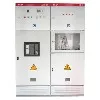
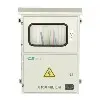
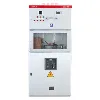
The circuit breaker is generally composed of a contact system, an arc extinguishing system, an operating mechanism, a tripper, a shell, etc.
When there is a short circuit, the magnetic field generated by the high current (generally 10 to 12 times) overcomes the reaction spring, the tripper pulls the operating mechanism to act, and the switch trips instantaneously. When overloaded, the current becomes larger, the heat generation intensifies, and the bimetal sheet deforms to a certain extent to push the mechanism to act (the larger the current, the shorter the action time).
If there is an electronic type, the transformer is used to collect the current of each phase, and compared with the set value, when the current is abnormal, the microprocessor sends a signal to make the electronic tripper drive the operating mechanism to act.
A circuit breaker is a switchgear that can close, carry and break the current under normal circuit conditions and can close, carry and break the current under abnormal circuit conditions within a specified time. The circuit breaker is generally composed of a contact system, an arc extinguishing system, an operating mechanism, a tripper, a shell, etc. The circuit breaker is divided into high-voltage circuit breaker and low-voltage circuit breaker according to its scope of use, and the division of high and low voltage boundaries is relatively blurred, and the circuit breaker above 3KV is generally called high-voltage electrical appliances.