

Hey there! As a supplier of 63A AC circuit breakers, I often get asked about how these little power - protectors respond to harmonic currents. So, let's dig into it!
First off, what are harmonic currents? In an ideal AC power system, the voltage and current waveforms are pure sine waves. But in the real world, non - linear loads like computers, variable - speed drives, and LED lights distort these waveforms. These distorted waveforms can be thought of as a combination of the fundamental frequency (usually 50Hz or 60Hz) and a series of higher - frequency components called harmonics.
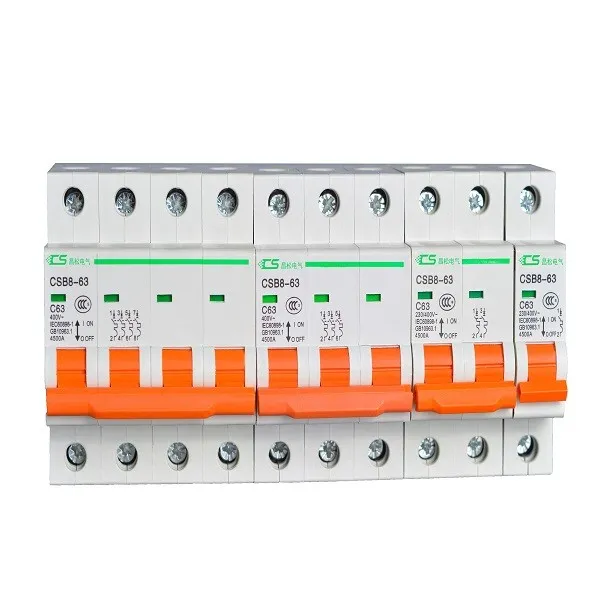
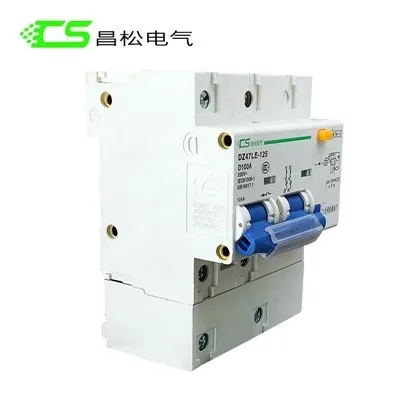
Now, let's talk about our 63A AC circuit breakers. These breakers are designed to protect electrical circuits from overcurrents, short - circuits, and other electrical faults. But how do they deal with harmonic currents?
The thermal - magnetic mechanism is a common design in our 63A AC circuit breakers. The thermal part of the breaker responds to the heating effect of the current. When the current exceeds the rated value, the heat generated by the current causes a bimetallic strip to bend. This bending action eventually trips the breaker, cutting off the power. However, harmonic currents can mess with this process.
Harmonics increase the effective current in the circuit. The root - mean - square (RMS) value of the current, which is what the thermal element of the breaker senses, is affected by the presence of harmonics. Since the heating effect of the current is proportional to the square of the RMS value, even a small amount of harmonic current can cause additional heating. This means that the breaker might trip earlier than expected, even if the fundamental current is within the rated 63A.
On the other hand, the magnetic part of the breaker is designed to respond quickly to short - circuits. It uses an electromagnet that generates a magnetic field proportional to the current. When the current reaches a certain high level, the magnetic field is strong enough to pull a latch and trip the breaker. Harmonic currents, especially high - frequency ones, may not have a significant impact on the magnetic element because the magnetic field generation is mainly related to the magnitude of the current rather than its frequency. But in some cases, if the harmonic currents are large enough to cause a sudden spike in the overall current, it could potentially trigger the magnetic trip mechanism.
Another factor to consider is the breaker's impedance at different frequencies. Our 63A AC circuit breakers have a certain impedance at the fundamental frequency. As the frequency of the harmonic currents increases, the impedance of the breaker may change. This change in impedance can affect the flow of harmonic currents through the breaker and how it responds to them. For example, at higher frequencies, the skin effect comes into play. The skin effect causes the current to flow more on the outer surface of the conductor, increasing the effective resistance. This increased resistance can lead to more power losses and additional heating in the breaker.
Now, let's take a look at some of the products in our range that are related to this topic. The MiniMelt Mechanism is a unique feature in some of our circuit breakers. It offers enhanced protection and can handle different types of electrical conditions, including those affected by harmonic currents. The Rcbo Circuit Breaker combines overcurrent protection with residual current protection, which is crucial in modern electrical systems with a lot of non - linear loads. And if you're looking for a complete power distribution solution, our Smart Power Distribution Cabinet can integrate multiple 63A AC circuit breakers and manage the power flow effectively, even in the presence of harmonic currents.
To mitigate the effects of harmonic currents on our 63A AC circuit breakers, we've done a lot of research and development. We've optimized the design of the thermal and magnetic elements to be more resilient to harmonic - induced heating and false tripping. We also use high - quality materials with stable electrical properties at different frequencies.
In some cases, additional filtering devices can be used in the electrical system to reduce the level of harmonic currents before they reach the circuit breaker. This can help to extend the lifespan of the breaker and ensure more reliable operation.
If you're in the market for 63A AC circuit breakers or have any questions about how they handle harmonic currents, don't hesitate to reach out. We're here to help you find the best solution for your electrical needs. Whether you're working on a small residential project or a large industrial installation, our 63A AC circuit breakers are designed to provide reliable protection.
Contact us today to start a procurement discussion. We can offer you detailed product information, technical support, and competitive pricing. Let's work together to build a safer and more efficient electrical system!
References
- "Power System Harmonics: Fundamentals, Analysis, and Filter Design" by Math H.J. Bollen
- IEEE Standard 519 - 2014, "IEEE Recommended Practices and Requirements for Harmonic Control in Electrical Power Systems"


